
Earthquake victims affected by the 2023 Jajarkot earthquake have not yet received government grants to build their houses. Because of this, they are still living under tarpaulins and tin roofs. Forced to spend winters and monsoons in temporary shelters, new mothers, the elderly, girls, and those with chronic illnesses are dying prematurely.
--- ---
On February 11, 2025, the fading light of the setting sun glimmers on the face of Gope Sunar, a resident of ward 9, Kushe Rural Municipality, Jajarkot. He stares blankly towards the Bheri River, which murmurs at the end of Rimna market.
A year has passed since he cremated his wife, who had given birth just a month before, on the same riverbank. Yet, he is still grieving her loss. "How can I forget that day?" he says, his expression changing as he speaks. He then falls silent for a long time.
On November 3, 2023, his family was spared from the magnitude 5.4 earthquake centered in Ramidanda, Jajarkot, even though their house was destroyed. At the time, his wife, Kalpana Nepali (24), was seven months pregnant. According to Gope, after their house became uninhabitable, they built a temporary shelter for his pregnant wife.
 Kalpana gave birth to a son on December 3. She continued to live in the shelter even after giving birth. Less than a month later, on December 27, 2023, Kalpana was found dead in her sleep.
The cold had been intensifying since they moved into the shelter. Living under a tarpaulin, her health deteriorated due to the cold. "Her body started to swell from the cold since we moved outside," her husband, Gope, said. "She had been sick since giving birth. We waited, hoping she would get better, but she didn't. The cold took the life that the earthquake had spared."
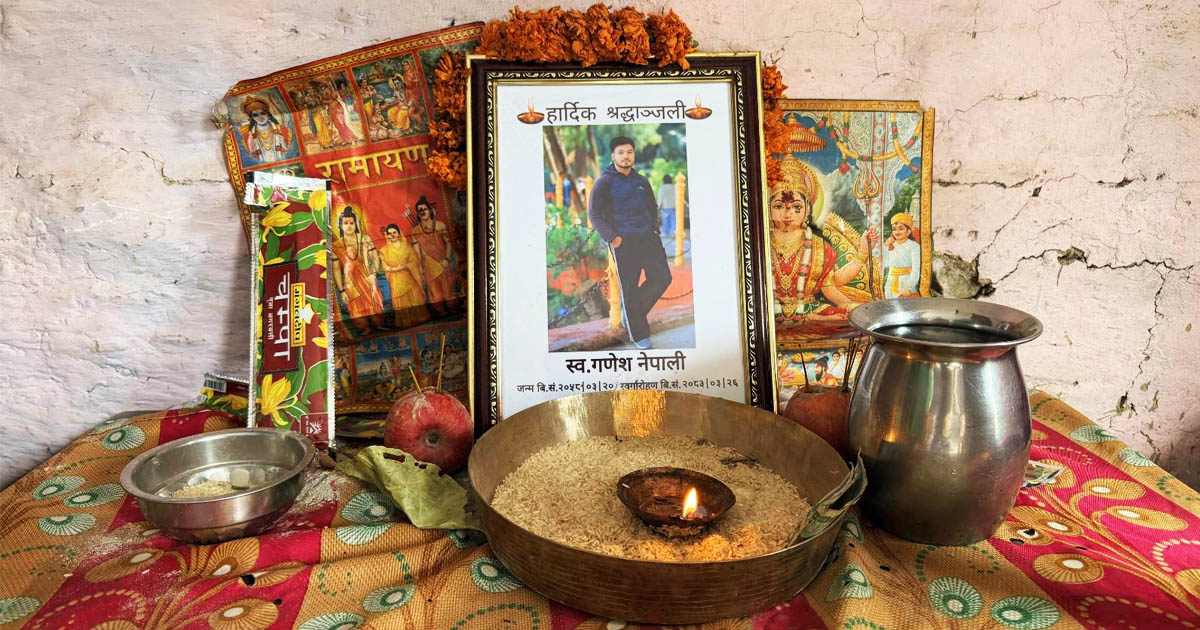
Another new mother, Sharmila Chadar (25) from ward 8, Tallosima, Nalgad Municipality, also died from the cold on November 27, 2023, because the tarpaulin couldn't protect her from the cold.
After the earthquake damaged her house, she was living in a shelter made of tarpaulin. She was a new mother of a month-old baby when the stay under the tarpaulin led to a severe cold and fever.
According to Tej Bahadur Singh, the ward chairperson of ward 8, Nalgad Municipality, she fell ill due to the cold and didn't receive timely treatment. "She was living under a tarpaulin outside her damaged house," he said. "The tarpaulin couldn't block the dew, and she became seriously ill from the cold." She died on November 27 after being taken to the hospital.

Earthquake victims in Jajarkot and Rukum are still living in temporary shelters since 2023. Children, the elderly, and new mothers are at risk from the rain in the monsoon and the cold in the winter. Pregnant women and new mothers in the shelters are suffering from health problems like body swelling and pneumonia. Newborns are also showing serious health issues like pneumonia.
According to data collected by the Nepal Investigative Multimedia Journalism Network (NIMJN), 39 people have died from the cold over the past two years. They lost their lives prematurely because the government was unable to provide safe housing after the earthquake.
Pregnant and new mothers in temporary shelters
Sapana Pun (19), from Ginikoth, Sanibheri Rural Municipality-2, has also been living in a temporary shelter since the earthquake destroyed her house. When we visited her in the last week of January, she had given birth two months earlier. Sitting in the midday sun with her baby in her lap, she described the hardships of spending nights in the shelter next to her damaged home. "We have been sleeping in a shelter since the house collapsed," she said, pointing to her baby. "My baby is also with me in this shelter."
She remained in the shelter throughout her nine-month pregnancy. At that time, she suffered from various health issues due to the cold inside the shelter. She somehow survived the rain and the bitter cold, holding on to the hope that "the government would build a house soon."
However, even after her baby's birth, the reconstruction work has not moved forward. Her fate of spending nights in a shelter, from pregnancy to becoming a mother, has not changed. "The tin roof gets scorching hot during the day," she says. "In the winter, it gets so cold that you can't sleep."
She says she and her baby are facing health problems in the shelter and is worried about her child. She has been experiencing health issues like swollen feet.
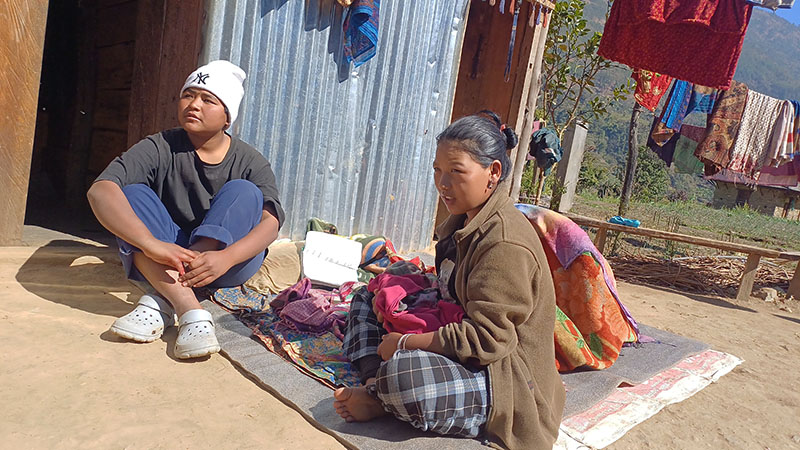
Sapana is not the only one spending nights in a temporary shelter after giving birth. Rita Khadka (23), from the same village, is also a new mother of a four-month-old and is raising her newborn in a temporary shelter.
Just like Sapana, she is also facing health issues while raising her child in a shelter. She and her baby are suffering from severe colds and coughs. "The cold dew at night makes the bedding damp," she said. "And the scorching heat from the tin roof in the summer makes it unbearable to stay inside." She is also worried about how to protect her four-month-old baby.
Due to the government's delay in reconstruction after the earthquake, victims in shelters are enduring the heat, cold, and rain. According to Dr. Mahesh Chaulagain, the head of the Health Services Office in Rukum West, the victims in the shelters are falling sick. He says the health of pregnant and new mothers and their infants is particularly at risk. "The pregnant and postpartum period is a sensitive time for women," he said. "Both the mother and the baby need special care, warm housing, and proper attention, but the women in the shelters are not getting this."
According to him, living in the shelters throughout the year is causing problems like bleeding, anemia, and reproductive health issues for pregnant and new mothers. He says that they are also experiencing diarrhea and pneumonia. "The cold is causing common problems like pneumonia, cold allergies, and diarrhea in both mothers and babies," Dr. Mahesh says. "In the long run, this can lead to serious health problems for both of them."
Furthermore, pregnant women and new mothers in the shelters are not receiving adequate health services, and their infants are not getting proper nutrition. "Pregnant women in the shelters are not even getting enough food," Dr. Mahesh said. "The condition of the mothers and babies here is dire." He added that without proper nutrition, the babies are at risk of malnutrition.
An ailing person in every temporary shelter
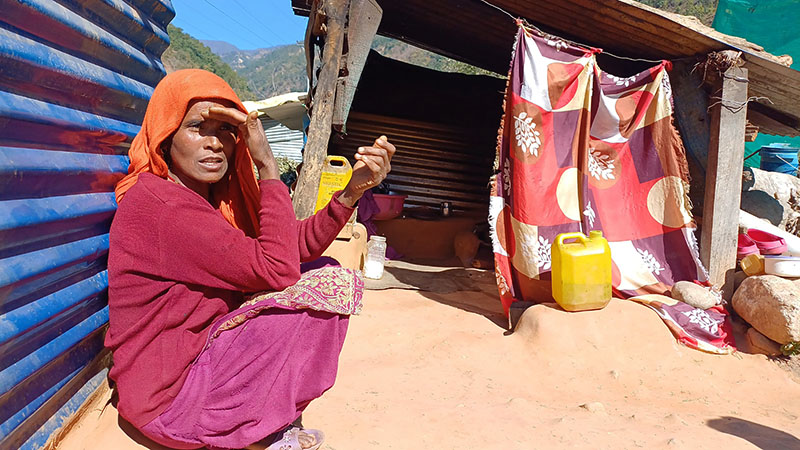
Lali and Karna Bahadur BK, a couple from Aathbiskot Rural Municipality-14, Rukum West, have been living in a temporary shelter since the earthquake completely destroyed their house. The couple, now in their sixties, has spent summers, winters, and monsoons in a shelter made of tin, wood, and a tarpaulin.
Their lives have not been the same since they were forced to live in a shelter. The couple, who were healthy before the earthquake, are now battling one illness after another.
Since moving to the shelter, Karna Bahadur has been suffering from asthma. Last year, the cold made his asthma much worse. After spending two winters in the shelter, his health problems have been flaring up repeatedly.
"The shelter made of tin and tarpaulin doesn't block the cold. In winter, dew freezes on the tin at night, and it drips onto the bedding," he said. "The damp bedding from the dew makes the cold worse, causing me to cough and have breathing problems all year round."
He says that even though he survived the natural disaster, he is now worried about how to protect himself from the health problems caused by the cold.
Kali Rana from Rimna, Bheri Municipality-1, Jajarkot, is also suffering from a cough and pneumonia. She has been living in a shelter since the earthquake cracked her house in half. "The house is half-destroyed and not fit to live in," she said.
She had heard that the government would provide housing for the victims after the earthquake. But as two years approach, there is no sign that the government will build them a house. "We are losing hope that the government will build us a house," she says. "Ever since the house was destroyed, we have had no food to eat, no shelter to live in, and no money for treatment if we fall sick."
Tej Bahadur Singh, the ward chairperson of ward 8, Nalgad Municipality, said that many of the earthquake victims who have been living in shelters for a year and a half are falling sick. "There are sick people in almost every shelter here," he said. "Among them, there are a lot of new mothers and newborns."
39 people died in temporary shelters
According to elected officials and local residents, people are dying in temporary shelters after the earthquake, but we could not obtain an accurate count from the rural municipalities or ward offices. We gathered and verified the data based on records from the local wards in the affected areas, statements from local residents, and the victims' relatives. We then confirmed the names of 39 people who died while living in temporary shelters after the earthquake, including senior citizens, new mothers, children, and people with chronic illnesses.
Local elected officials say that earthquake victims are dying in temporary shelters because the federal government has not paid attention to providing them with safe housing. Bir Bahadur Giri, the head of Barekot Rural Municipality in Jajarkot, says, "The victims are living in harsh conditions in temporary shelters after the earthquake. Many people in our municipality have also died in shelters."
Krishna Bahadur Khatri, the information officer at the Jajarkot Health Office, says that if the government does not immediately arrange for safe housing for the victims, this number is at risk of increasing further.
76,000 victims: Majority still living in temporary shelters
The magnitude 5.4 earthquake that struck Jajarkot on November 3, 2023, killed 154 people and injured at least 364 in Jajarkot and Rukum West. The earthquake happened at 11 p.m., when most people were asleep.
The earthquake completely destroyed 26,000 houses and partially damaged over 35,000. According to the National Disaster Risk Reduction and Management Authority, 76,326 families were affected by the Jajarkot earthquake.
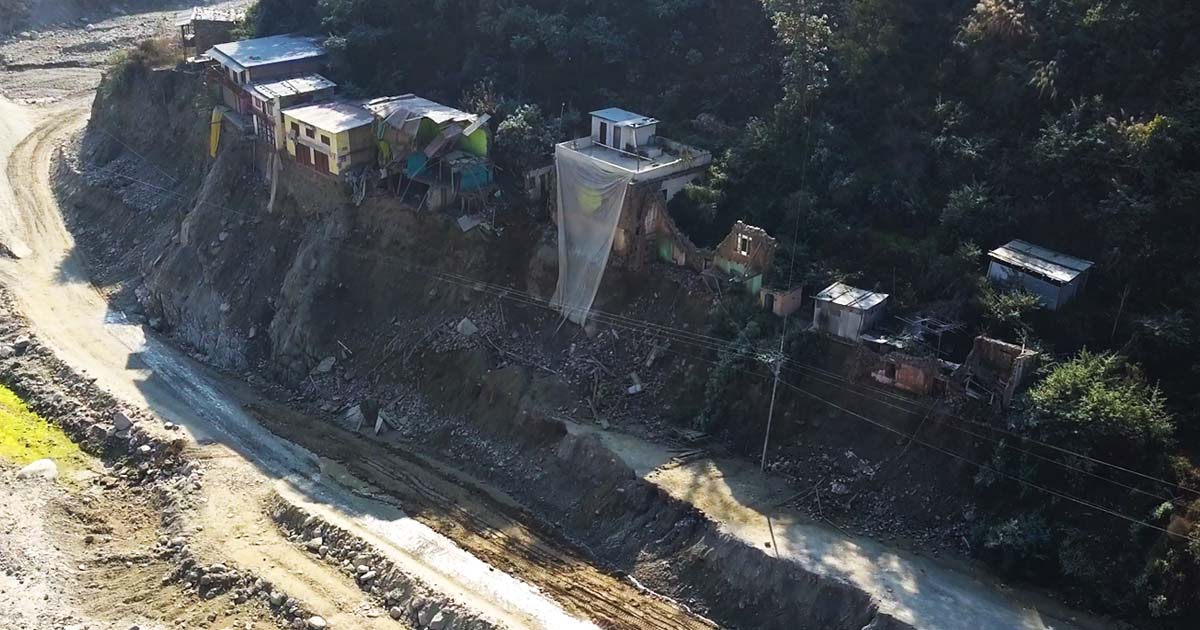
After their homes were destroyed, some people are living in their cracked houses, while others are in temporary shelters or under tarpaulins. Due to delays in the construction of permanent housing, some victims have built their own homes. However, those who cannot afford to build their own houses are living in temporary shelters made of tarpaulin, tin, and wood.
Dambar Bahadur Rawat, the mayor of Nalgad Municipality in Jajarkot, says that the victims are dying in temporary shelters because the government has not built houses in a timely manner. He sounds angry that the government is not serious about the lives of the victims, even after two changes in government. "The deaths of our citizens have not stopped even after the earthquake," he said. "Will the state take responsibility for this or not?"
Victims yet to receive installments to build temporary shelters
After the earthquake, the government announced it would immediately provide 50,000 rupees to victims to build temporary shelters. The amount was to be given in two installments of 25,000 rupees each. However, the earthquake victims have not received the full payment for their temporary shelters. Some have received the first installment, while others have not received any payment at all.
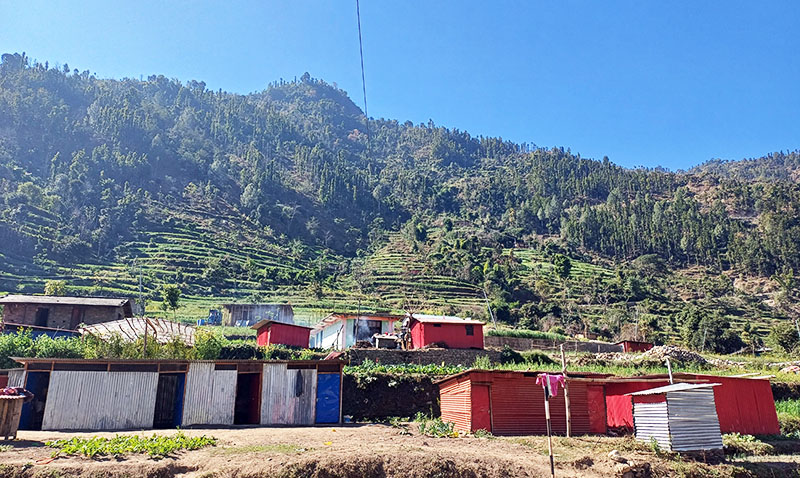
According to the Jajarkot District Administration Office, out of 48,516 earthquake victims, 40,041 beneficiaries have received the first installment for building temporary shelters. Only 6,663 people have received the second installment, and 8,475 have not received the first installment yet.
Similarly, according to the Rukum West District Administration Office, out of 34,917 people who are eligible for temporary shelters, 2,000 have not received the first installment. The rest have received both installments.
Why the delay in the construction of permanent housing?
The government had announced that it would build permanent private houses for the earthquake victims within a year and provide a grant of 500,000 rupees for that purpose. However, a year and a half after the earthquake, the construction of permanent housing for the victims has not yet begun.
According to the National Disaster Risk Reduction and Management Authority, there are several reasons for the delay in building permanent housing for the earthquake victims. One of the reasons is the delay in bringing the necessary work procedures for the construction of permanent housing. It was only on January 5, 2025, that the government issued the 'Disaster-Affected Private Housing Retrofitting, Reconstruction and Rehabilitation Grant Work Procedure, 2081 (First Amendment),' 14 months after the earthquake.
The authority also says that the necessary budget for building the houses was not released by the Ministry of Finance, which also caused some delay.
According to Ram Bahadur KC, the then spokesperson for the authority, the reconstruction work has now moved forward after the work procedure was issued and the budget was released. According to him, the work of identifying the actual beneficiaries—that is, the Detailed Damage Assessment (DDA)—has been completed for 96,000 victim families of the Jajarkot earthquake.
The DDA work has also been completed for the earthquake victims in Doti and Bajhang, along with Jajarkot.
What do the experts suggest?
Disaster expert Dr. Min Bahadur Paudel says there has been a significant delay in building permanent housing for the earthquake victims in Jajarkot and Rukum. "The situation is so dire that not all victims have even received the second installment for temporary shelters," he said. "While by now, permanent housing should have been completed."
According to him, providing safe housing is crucial for victims after a natural disaster like an earthquake. He says that after a natural disaster, vulnerable groups, especially women, pregnant women, new mothers, and senior citizens, should be identified and moved to safe places.
Dr. Min emphasizes that permanent housing should be arranged for the victims at least six months in advance.
He says that just rescue and relief work during a disaster is not enough. He adds, "Providing them with safe housing and healthcare services is important." He suggests that a special relief package targeting vulnerable groups should be implemented during and after a disaster.
Please adhere to our republishing policy if you'd like to republish this story. You can find the guidelines here.
Comments